Higher Bag Price, Lower Cost Per Acre? Run the Numbers.
What will your seed actually cost per acre? And how much could your payment options change the total?
A price per bag or an advertised interest rate only tells part of the story. Planting population, purchase discounts, and financing charges all affect what you spend.
New Horizon’s seed calculator helps you work through those numbers in two ways: compare seed costs per acre, then explore financing options for a planned purchase.
A higher bag price can still mean a lower cost per acre
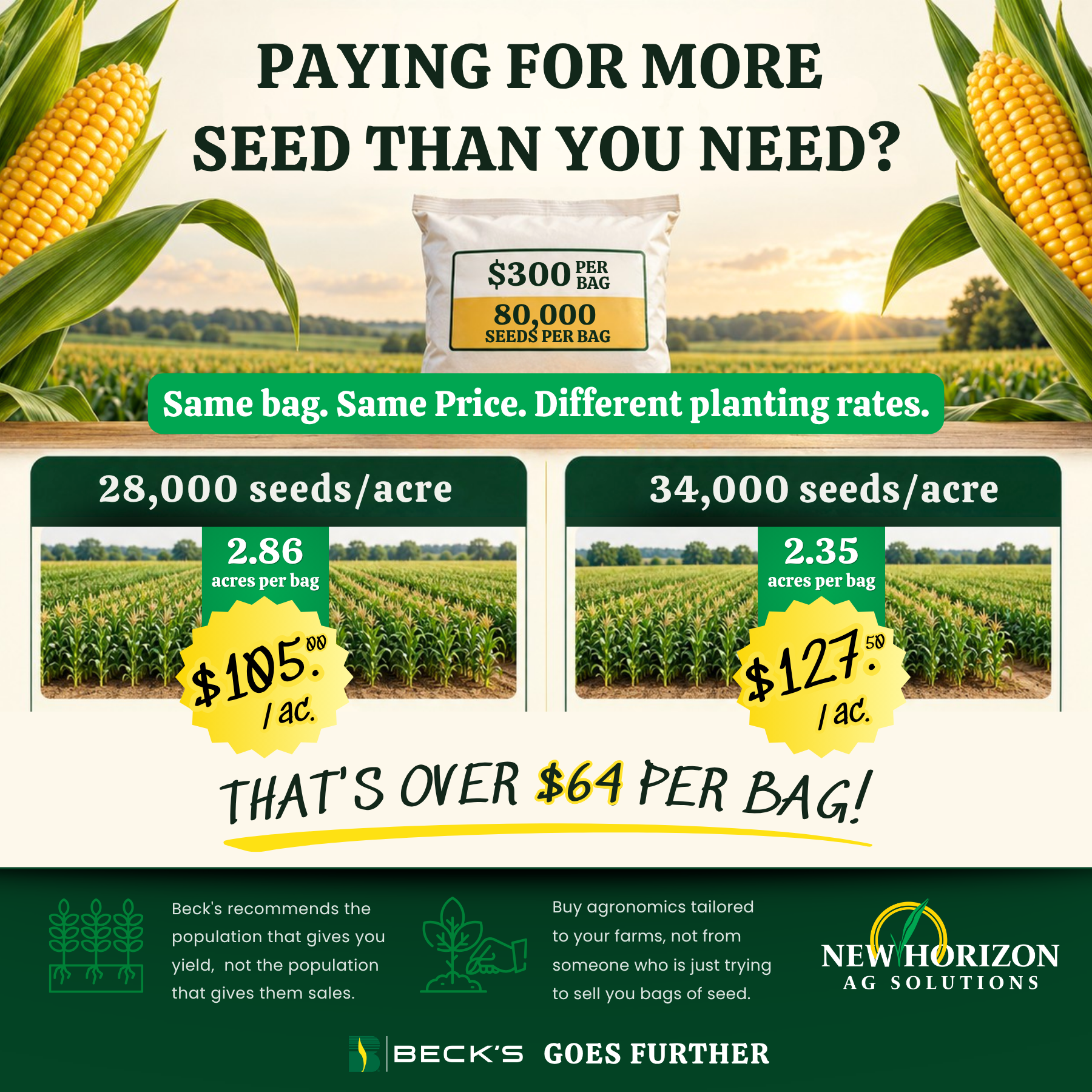
Every bag in the calculator contains 80,000 seeds. How many acres that bag covers depends on your planting rate.
At 28,000 seeds per acre, one bag covers approximately 2.86 acres. At 34,000 seeds per acre, it covers about 2.35 acres. That difference can offset a higher price per bag.
Here’s the example shown in the calculator:

| Company A | Company B | |
|---|---|---|
| Price per bag | $300 | $275 |
| Seeds planted per acre | 28,000 | 34,000 |
| Seeds per bag | 80,000 | 80,000 |
| Seed cost per acre | $105.00 | $116.88 |
Although Company A costs $25 more per bag in this example, its lower planting rate brings the seed cost down by approximately $11.88 per acre.
Across 1,000 acres, that’s $11,875 in estimated seed-cost savings. The total uses the unrounded calculations, which is why it differs slightly from multiplying the displayed $11.88 by 1,000.
These planting rates are examples, not recommendations for every field. The right population depends on your hybrid and field conditions. Use rates that fit your operation and talk with New Horizon about your planting plan.


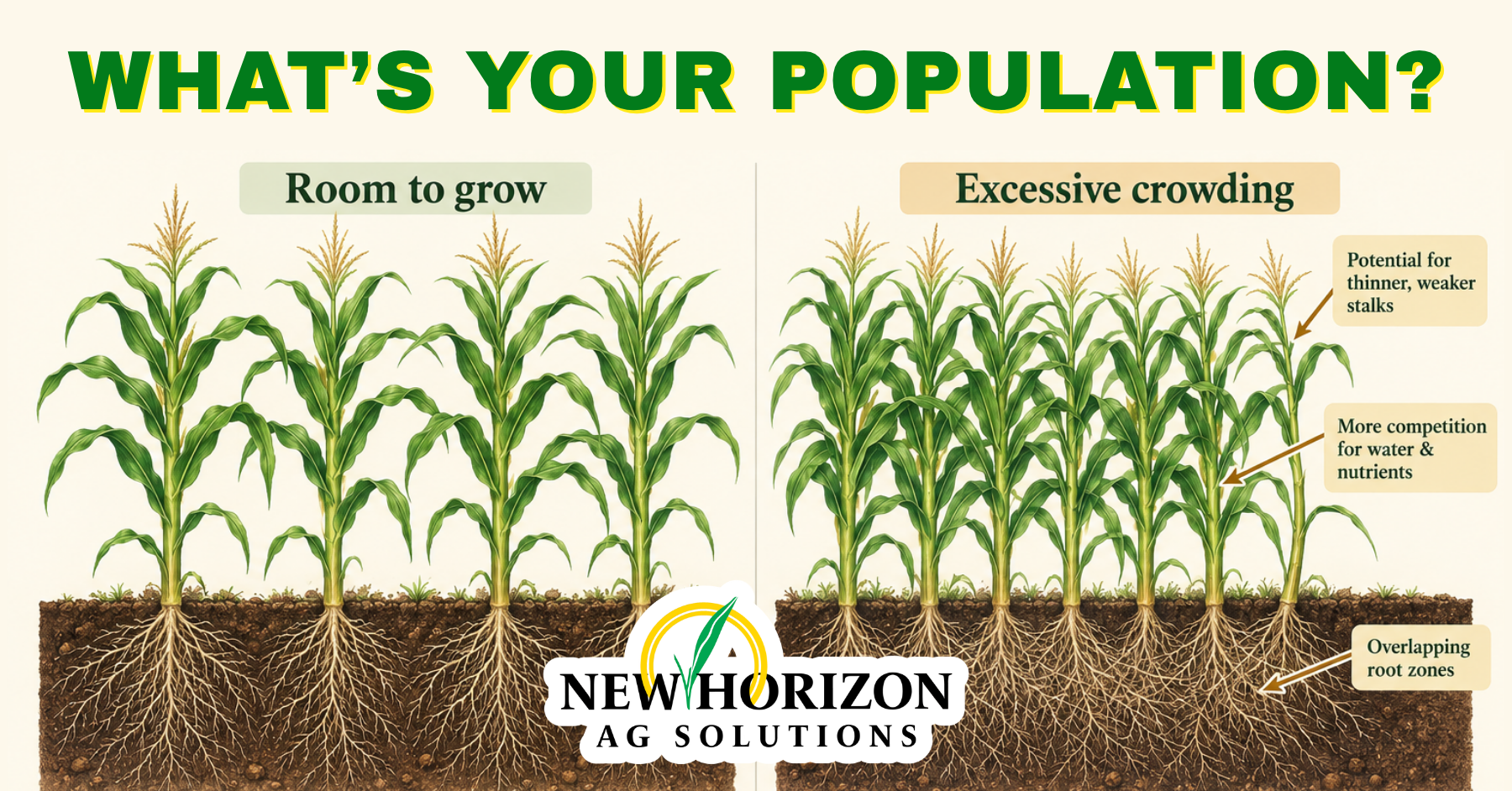
Higher populations need to earn their keep
It’s easy to focus on the price of a bag and overlook how quickly you plant through it. But planting rate directly affects seed cost per acre. Before paying for more seeds, ask what those additional plants are returning.
A higher stand count shouldn’t be the goal by itself. The goal is a population that delivers the best return for your hybrid and field. More seed sold means more revenue for a supplier; it only means more profit for you if the added yield pays for the added expense.
Beck’s has been testing that relationship. Its Product Characterization Research compared populations of 28,000, 34,000, and 40,000 plants per acre.
The findings support lower populations for hybrids with horizontal root systems and higher populations for those with vertical root systems—reinforcing why one planting rate doesn’t fit every hybrid. Read the research overview.
That doesn’t make 28,000 the right rate for every acre. It does make planting population a question worth asking before comparing bag prices.
The lower planting rate stretches an 80,000-seed bag across approximately 2.86 acres instead of 2.35. That brings the seed cost down even though the bag costs more.
How far does your bag go? Ask New Horizon about the research behind your hybrid’s recommended planting rate, then use the calculator to see what that rate means for your seed budget.
We don't believe in selling you seed you don't need. Every hybrid is different, and so is every field. Some genetics thrive at higher planting populations, while others benefit from having a little more room to grow. That's why we work with Beck's Hybrids research to make recommendations based on what works best for your acres.
Because at the end of the day, we'd rather help you get more bushels out of fewer bags than sell you extra seed that doesn't improve your bottom line.
Put your own numbers into the comparison
On the Cost per acre tab, enter your total acreage, each brand’s planting rate, and each brand’s price per bag. You can also add an operation name if you’d like.
The calculator shows:
- Beck’s seed cost per acre.
- The competitor’s seed cost per acre.
- The difference per acre.
- Estimated savings across your entered acreage.
For a fair comparison, treat discounts the same way in both bag prices. If one price is after discounts, the other should be too.
This comparison uses fractional bags without rounding up to whole bags. It excludes financing charges, taxes, and fees, giving you a focused look at seed expense. Lower seed cost alone does not establish higher yield or profitability.
Compare financing by the total cost
Next, the Financing comparison tab helps you see how discounts and interest work together.
A 0% interest offer may sound like the least expensive option. But a larger purchase discount can sometimes outweigh the interest charged by another option.
The calculator’s example starts with a $100,000 purchase before discounts and financing:
| Larger discount with financing | Competing offer | |
|---|---|---|
| Purchase discount | 15% | 7% |
| Discounted seed cost | $85,000 | $93,000 |
| Annual interest rate | 6.25% | 0% |
| Financing period | 12 months | 12 months |
| Financing charge | $5,312.50 | $0 |
| Estimated total cost | $90,312.50 | $93,000 |
With these inputs, ProPartners Financial, FirstMid Bank & Trust, and Rabo each show an estimated total of $90,312.50, which is $2,687.50 less than the competing offer!
That’s why it helps to compare the final dollar amounts alongside the advertised rates.
Explore the options for your purchase
In the financing section, you can enter your purchase amount, months financed, prime rate, Beck’s cash discount, and the competing offer’s interest rate and discount. An expandable cash-purchase section provides another assumption to review.
The results highlight the lowest estimated total and break out each option’s discounted seed cost, financing charge, and payment information.
Read the individual terms carefully. For example, the calculator labels John Deere’s financing period as a fixed 12 months and notes a 15% financing-discount cap for FirstMid, Rabo, and John Deere. Confirm current program details with New Horizon before making a purchase decision.
The two tabs, 'Cost per acre' and 'Financing comparison' answer separate questions. The cost per acre section compares planting scenarios; the financing section compares offers using the same purchase amount. Their example savings should not be added together.
Start with the numbers. Then talk through your plan.
Your seed purchase deserves a closer look than the price on the bag. This calculator gives you a practical starting point for understanding costs and comparing options.
Then bring your questions to the New Horizon team. From hybrid placement and planting populations to discounts and financing, we’re here to help you build a plan around your acres.
Calculator results are estimates. Confirm applicable rates, discounts, eligibility, fees, and payment terms before purchasing.